
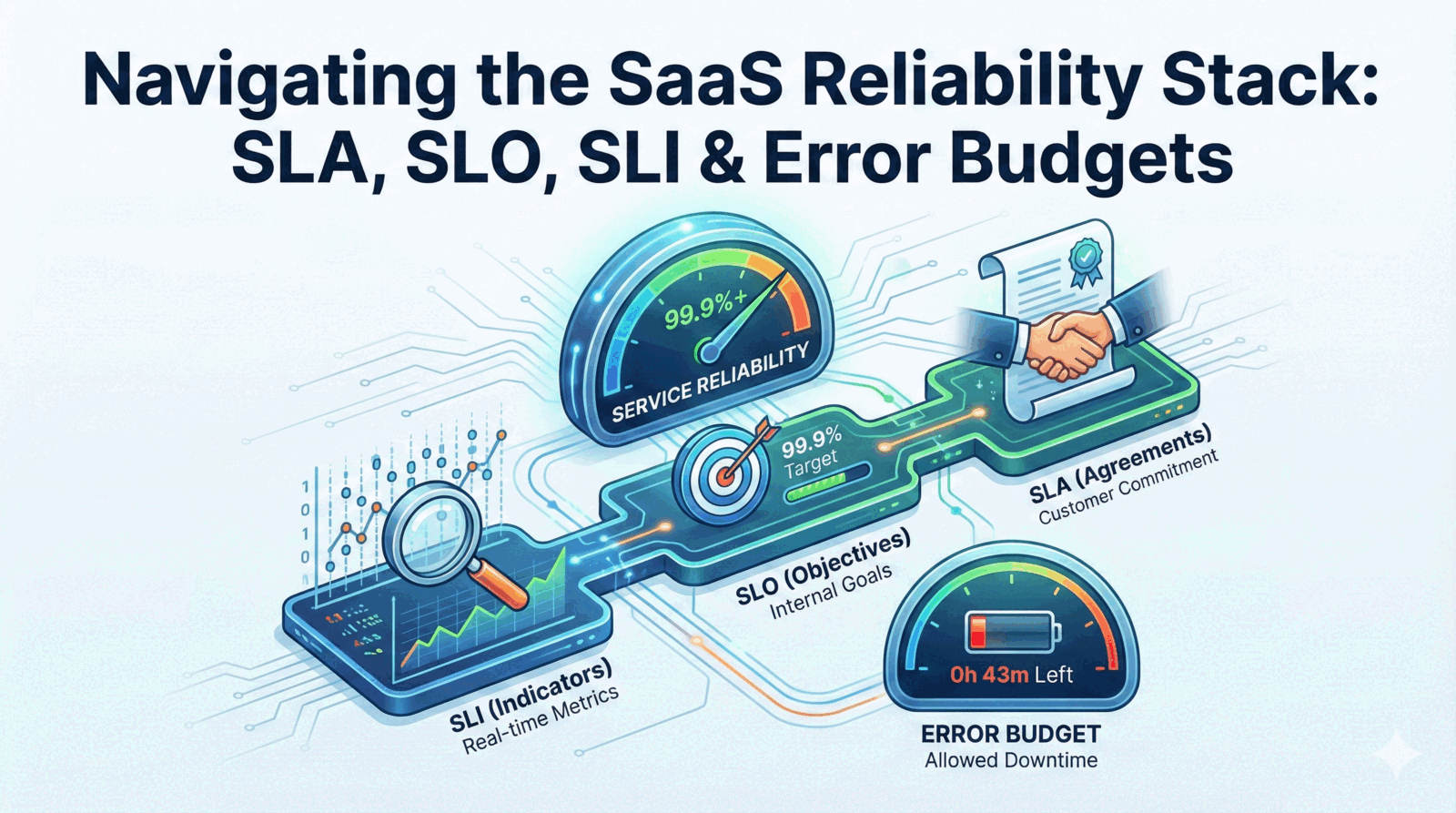
A comprehensive roadmap for establishing SLAs, SLOs, and Error Budgets that scale with your business
Key Insight: In the subscription economy, your product is only as good as its availability. For a modern CTO or founder, "uptime" is no longer just a technical metric for sysadmins—it is the fundamental currency of business trust.
The market has shifted from "growth at all costs" to "efficient growth," where customer retention is paramount. Downtime doesn't just annoy users; it kills the trust required to close enterprise deals.
This guide provides a comprehensive roadmap for establishing Service Level Agreements (SLA), Service Level Objectives (SLO), and Error Budgets. Whether you are a seed-stage startup or scaling toward a Series B, this is how you build a reliability strategy that scales with you.
1. The Reliability Stack: SLI, SLO, SLA
To manage reliability effectively, we must first deconstruct the terminology. These acronyms are often used interchangeably, but they serve distinct purposes in the engineering and business hierarchy.
1.1 Service Level Indicator (SLI): The "What"
The SLI is a quantitative measure of a specific aspect of your service—the "truth" about your system's behavior. Without defined SLIs, reliability discussions are based on feelings, not facts.
Best Practice: Don't measure everything. Focus on the "Four Golden Signals" of Google SRE:
- Latency: How long does it take to serve a request? (Focus on the 95th or 99th percentile, not the average).
- Traffic: How much demand is being placed on your system? (e.g., requests per second).
- Errors: What percentage of requests are failing?
- Saturation: How "full" is your service? (e.g., memory or CPU usage).
1.2 Service Level Objective (SLO): The "Target"
The SLO is the target value for your SLI. It represents the internal goal your engineering team strives to hit.
Crucial Insight: Your internal SLO should always be stricter than your external SLA. If you promise customers 99.9% availability, set your internal SLO to 99.95%. This creates a buffer, allowing your monitoring tools (connected to UpReport) to alert you before you breach a contract.
1.3 Service Level Agreement (SLA): The "Promise"
The SLA is the commercial contract with your customer. It defines the minimum acceptable level of service and the penalties (usually financial credits) if you fail to meet it.
SLO Breach:
An engineering signal to slow down and fix stability.
SLA Breach:
A legal and financial event that involves lawyers and refunds.
1.4 Error Budget: The "Bridge"
The Error Budget is the most powerful management tool in this stack. It is calculated as 100% - SLO .
If your SLO is 99.9%, your error budget is 0.1%.
This budget is a resource. You can "spend" it on risky deployments, database migrations, or chaos engineering. As long as you have budget remaining, you push features fast. If you exhaust the budget, you freeze features and focus on stability.
2. The Mathematics of "Nines"
Understanding the cost of each "nine" is critical for financial planning. Moving from three nines to four nines typically involves a 10x-20x increase in infrastructure cost and engineering complexity.
2.1 The Cost of Uptime
| Availability | Annual Downtime | Monthly Downtime | Typical Stage | Requirements |
|---|---|---|---|---|
| 99.0% | 3d 15h 39m | 7h 18m | Seed / MVP | Monolith, manual recovery. |
| 99.5% | 1d 19h 48m | 3h 39m | Early SaaS | Basic redundancy, load balancers. |
| 99.9% | 8h 45m | 43m | Scale-up (Standard) | Automated failover, on-call rotation. |
| 99.99% | 52m | 4m | Enterprise | Multi-region active-active, fully automated self-healing. |
Reality Check: At 99.99%, you have 4 minutes of downtime per month. Humans cannot react in 4 minutes. If you promise four nines, you are promising that your machines can fix themselves.
2.2 The "Composite SLA" Trap
Modern SaaS is rarely a monolith; it relies on AWS, Stripe, Auth0, OpenAI, etc.
If your app (99.9%) relies on a Database (99.9%) and an Auth Provider (99.9%), your theoretical maximum availability is not 99.9%. It is the product of all components:
0.999 × 0.999 × 0.999 ≈ 99.7%
Takeaway: Be very careful not to promise an SLA higher than the composite SLA of your critical dependencies.
3. Protecting the Company: Legal Best Practices
While engineers worry about uptime, founders must worry about liability. A poorly drafted SLA can expose your startup to unlimited damages.
Disclaimer: This section provides general guidance for informational purposes only and does not constitute legal advice. Consult a qualified attorney before finalizing any SLA terms.
3.1 The "Sole Remedy" Clause
This is a critical safety valve in your contract, often referred to as the 'Sole and Exclusive Remedy' clause. While it doesn't legally forbid a customer from filing a lawsuit, it contractually limits your liability for ordinary downtime to the agreed-upon Service Credits. Without this clause, you could theoretically be liable for unlimited damages (like their lost revenue) caused by your outage. Note: Generally, this protection does not apply in cases of gross negligence or willful misconduct.
3.2 Standard Exclusions
You must explicitly exclude scenarios that are out of your control or involve planned work. However, be careful not to exclude things that are your responsibility (like your server architecture).
- Scheduled Maintenance: Permissible provided you give advance notice (e.g., 48 hours or 5 business days) via your UpReport status page.
- Force Majeure: Strictly defined events like wars, acts of terrorism, natural disasters (earthquakes, floods), or government acts.
- General Internet Problems: Outages caused by factors outside your direct control, such as DNS backbone failures or the customer's ISP issues.
- Customer Error: If a customer breaks their integration, misconfigures their firewall, or breaches the Terms of Service (e.g., DDoS-ing you), that is not your downtime.
Pro Tip: Some early-stage startups try to exclude "Upstream Provider Outages" (e.g., AWS/Azure failures). Be aware that Enterprise clients will often reject this exclusion, arguing that redundancy and failover are your responsibility.
3.3 Service Credit Structure
Avoid cash refunds. Use credits for future service to ensure retention. Example:
Total credits are typically capped at 100% of the monthly fee.
4. Evolution Strategy: From Seed to Enterprise
Don't implement Google's processes when you are a team of five. Match your reliability strategy to your company stage.
Phase 1: The Startup (Seed / Series A)
- Goal: Product-Market Fit.
- SLA Strategy: "Best Effort". Don't offer a binding SLA in your standard terms. If a large pilot customer insists, offer a non-binding "Target Availability" of 99.5%.
- Tooling: Set up a public status page with UpReport. Add basic HTTP checks and Pulse (heartbeat) monitors for critical services. Connect your error tracking (like Sentry) to catch issues before users report them. Post manual updates during incidents—at this stage, transparency matters more than perfection.
Phase 2: The Scale-Up (Series B)
- Goal: Efficiency and Retention.
- SLA Strategy: Standard 99.9% SLA with Service Credits.
- Process: Introduce Error Budgets. Use the "Burn Rate" metric to decide when to freeze feature deployments.
- Tooling: Scale up your monitoring with UpReport's built-in checks (HTTP, ICMP, Pulse) or connect existing tools like Datadog or New Relic. When something goes down, your status page updates automatically. Use AI-generated drafts to write incident updates faster, and set up email and Slack notifications to reduce support ticket volume.
Phase 3: The Enterprise
- Goal: Governance and Brand Protection.
- SLA Strategy: Tiered SLAs. Offer 99.99% only to Premium Enterprise plans, priced to cover the cost of multi-region redundancy.
- Process: Formal SRE teams and SOC2 compliance.
- Tooling: Use public and internal visibility—your team sees detailed technical updates while customers see polished summaries. Enable multi-language status pages for global audiences. Use AI to translate your internal notes into customer-ready messages with one click.
5. The Role of the Status Page: Communication Templates
Technical availability is binary (up/down), but "psychological availability" is a spectrum. Customers are far more forgiving of downtime if they feel informed. During an outage, you don't want to be drafting copy from scratch.
Use this 4-Phase Incident Lifecycle Protocol:
Phase 1: Investigating
Triggered immediately after an alert fires. The goal is to acknowledge the issue publicly and set expectations for the next update.
"Some users may experience slower loading times when accessing the dashboard. We're aware of this and our team is working on it. Next update in 15 minutes."
Phase 2: Identified
The root cause is known but not yet fixed. Share what was found in simple terms and provide an estimated resolution time.
"We've found the cause—our servers are experiencing unusually high demand. We're deploying a fix now. Service should return to normal within the next 30 minutes."
Phase 3: Monitoring
The fix has been deployed and you are verifying stability. Inform customers that the situation is improving but you are still watching closely.
"The fix is in place and performance is returning to normal. We're keeping a close eye on things to make sure everything stays stable."
Phase 4: Resolved
The incident is fully closed. Confirm resolution and thank customers for their patience.
"Everything is back to normal. Thank you for your patience—if you have any questions, please reach out to our support team."
The "Sea of Green" Fallacy
Many founders fear showing red on their status page. They want a "Sea of Green" (100% uptime history). This is a mistake. A status page with no recorded incidents looks suspicious to an experienced buyer.
UpReport Tip: Showcasing Uptime Badges with a realistic history of minor incidents builds competence trust. It shows you can detect and resolve issues, which is more reassuring than a fake "perfect" record.
Summary Checklist for UpReport Users
- Define your Golden Signals: Start measuring Latency and Error Rate today.
- Buffer your SLO: Set your internal target (99.95%) higher than your customer promise (99.9%).
- Draft your "Sole Remedy" clause: Protect your downside legally.
- Automate Trust: Set up your UpReport status page to handle communication automatically during the "fog of war" of an incident.
- Don't over-promise: Calculate your Composite SLA before signing that enterprise contract.
Reliability is a feature. By treating your SLA as a product feature rather than a legal burden, you turn uptime into a competitive advantage.